
Reading Questions
Reading Answer Explanations
2014-2015 Specialized High Schools Student Handbook
(Questions in new window/tab)

2013-2014 Specialized High Schools Student Handbook
(Questions in new window/tab)

2014-2015 Specialized High Schools Student Handbook
(Answers in new window/tab)
2013-2014 Specialized High Schools Student Handbook
(Answers in new window/tab)
PASSAGES
Passage 1:
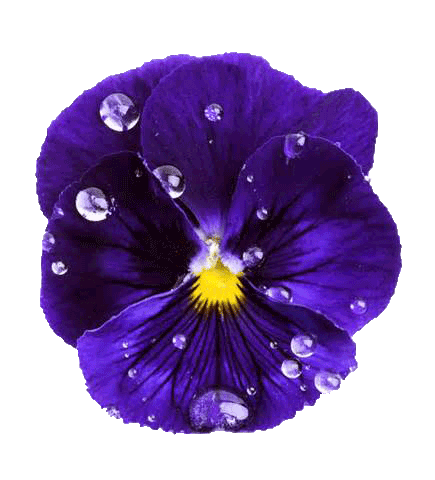
One hundred and fifty million years ago, flowers were not as colorful as they are today. Blossoms that contained the pigment chlorophyll, such as oak blossoms, were green; otherwise, flowers lacking chlorophyll were white, like dogwood blossoms. Over millions of years, according to current theory, the coloration of individual blossoms was occasionally altered by genetic mutations.
10
Mutations are, in effect, errors in the genetic codes inherited from parent plants. For example, the yellow in daffodils began with a mutation of the gene that carries instructions for the use of carotene, a yellow pigment that the plant uses to make food. Although the blossoms of most wild plants are still green or white, there are more colors now than there were 150 million years ago. Of these newer colors, yellow shades
20
are the most common, followed by orange and red, including shades of pink. Blue flowers are the rarest, because relatively few mutations resulted in that color. If a color-related genetic mutation helps a plant to survive, that gene may be passed from the parent to its offspring. Many flowering plants reproduce by means of pollination, a process that requires outside assistance. Some plants are pollinated by
30
the wind, a few by water. Others are pollinated by flying creatures such as insects, bats, and hummingbirds. Moreover, plant breeders deliberately cross-pollinate certain flowers to cultivate desirable traits, such as the unusual colors of some “designer” rose varieties.
Bird and insect pollinators seek out blossoms because they are looking for nectar, the sugary liquid in the heart of a
40
flower. When the first color mutations appeared millions of years ago, the colorful blossoms became more noticeable and were visited more frequently. When the flying creatures drank the nectar from a flower, their bodies brushed against the pollen and carried it to the next plant, unintentionally fertilizing the plants as they went along. As a result, the more colorful plants were more likely to reproduce.
50
Many plants are pollinated only by day oronly by night. Insects that are active during the day notice certain bright colors. Bees, for example, can distinguish hues of yellow and blue, but they cannot see red. Hummingbirds are strongly attracted to red blossoms, and some red flowers, such as the cardinal flower, are pollinated only by hummingbirds. Night-flying moths are
60
attracted by white flowers, whose paleness is visible by moonlight. Many night pollinated flowers also have fragrances that are attractive to moths. Over millions of years, the combination of color mutations and pollination by flying creatures has led to an abundance of colorful blossoms across the earth.
Passage 2:
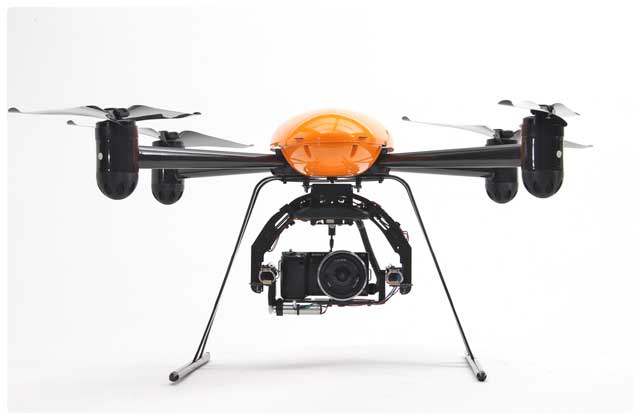
Most movies about spies and undercover agents feature fascinating special equipment. Many of these gadgets exist only in the imaginations of script writers, but others are actually used in espionage activities. One device with a surprisingly long and colorful history, both in and out of the cloak and dagger world, is the concealed camera. In the late nineteenth century, “detective cameras” were popular with amateur
10
photographers who wanted to take snapshots of unsuspecting people on the street. The camera was usually carried in plain view. Its disguise was simple: it was a plain box resembling a large and rather heavy parcel or a piece of luggage, with no external lens or controls. When people caught on to the deception, though, designers began hiding cameras in other objects, ranging from hats and books to purses and pocket
20
watches. One concealed camera even looked like an ordinary camera, but had mirrors that allowed users to take photographs at a right angle to the direction of whatever the photographer seemed to be viewing. Although most early spy cameras were meant to be used on the ground, cameras have been hidden in the sky almost from the beginning of photography. In World War I, both sides realized the strategic
30
value of taking aerial photographs of enemy territory from the newly invented airplane. To spy more discreetly, without the use of airplanes, the Germans attached cameras to homing pigeons and sent them over French army positions. Timers were set to trigger the cameras when the pigeons were expected to be flying over their targets. That particular attempt proved impractical, but the idea behind it did not: aerial photography
40
became a staple of World War II.
In the mid-twentieth century, a new era of spying with cameras began under the Cold War. This was a period of worldwide tension and competition between the Communist world, led by the Soviet Union, and the Western world, represented by the United
States and its allies. The conflict was expressed through propaganda, arms races, and especially espionage. During the Cold
50
War, both sides competed to develop new technologies to use photography in spying. Sophisticated concealed cameras were put in matchboxes, pens, rings, cigarette lighters, makeup cases, guns, and even hidden in clothing, with the lens concealed in a button. Almost any object that could be carried without attracting attention was probably made into a camera and carried by an undercover agent. Cameras were also
60
hidden in furniture and office machines such as copiers, which took photos of every document that was copied. The development of the long-range telephoto lens even allowed spies to take clear photos from a distance, such as across the street from an embassy. Today, space has proven to be the ultimate location for hidden cameras, as satellite mounted cameras can produce highly detailed photographs of objects anywhere
70
on earth.
Passage 3:

The eruption of the Philippine volcano Mount Pinatubo in June 1991 sent a huge cloud of gas and dust encircling the globe. The dust and ash from Mount Pinatubo was blamed for a two-year decrease in global temperature, changes in weather patterns, and damage to the ozone layer. The situation brings to mind a meteorological event that occurred 175 years earlier. At that time, harsh weather conditions plagued
10
much of eastern North America, and, to a lesser extent, northern Europe. April 1816 brought typical spring weather to upstate New York and New England; trees budded and farmers prepared to plow and plant. In May, however, the expected warm temperatures failed to arrive. Most people remained optimistic, waiting for the summer that was “just around the corner.” They waited in vain. June ushered
20
in what modern meteorologists call “The Year Without a Summer.” During the first week of June, ten inches of snow fell on New England. Throughout the month, temperatures rarely rose above the 30s. Many farmers replanted crops several times, only to see them stunted or destroyed by sleet, hail, and icy winds. July and August brought little improvement. During most days the temperature stayed in the 40s.
30
Farmers’ diaries document their daily struggles with near-freezing temperatures, failing crops, and dying farm animals. The few crops that managed to survive were killed by frost in mid-September. Winter came early in New England and was unusually severe. Even the South was affected; on July 4, the high temperature for Savannah, Georgia, was only 46 degrees!
Some religious leaders warned their congregations
40
that the unusual weather meant that the end of the world was drawing near. Other leaders attributed the cool weather to unusual sunspot activity. The proliferation of the newly invented lightning rod was also blamed. Some people believed that lightning rods had interrupted the natural temperature balance of the earth, causing the cooler temperatures. It was not until October that the first plausible
50
explanation for “The Year Without a Summer” was suggested. A German astronomer, Friedrich Bessel, reported seeing thick clouds of dust in the upper atmosphere. He theorized that these dust particles screened portions of the earth from the warming rays of the sun. It was discovered that, in April 1815, Mount Tambora, an Indonesian volcano, had erupted with such force that it had sent an estimated 100 cubic miles of
60
fine dust into the atmosphere. Witnesses to the eruption reported that the sky remained dark for two days. The dust then rose high into the stratosphere, where it encircled the world for several years to come. Skeptics in 1816 doubted that a far-away volcano could steal their summer. However, most present-day researchers believe Bessel’s explanation to be generally correct, demonstrating the global nature of weather.
70
The dust in the atmosphere eventually settled, and the spring of 1817 was back to normal.
Passage 4:
As France moved toward revolution at the end of the eighteenth century, a new artistic style, Neoclassicism, gave expression to the changed attitudes that contributed to the fall of the French monarchy. Most art from the first half of the eighteenth century had been decorative and sentimental. Subjects of paintings were typically domestic scenes or stories from mythology containing simple moral lessons. With the advent of the
10
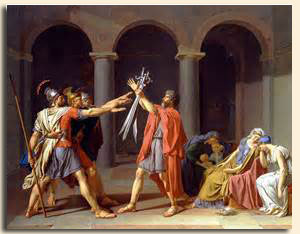
Neoclassical movement, however, art began to return to the classical style and heroic themes of the ancient Greeks and Romans. The new movement was largely defined by the work of Jacques-Louis David, although he was not its founder. His 1785 painting The Oath of the Horatii is considered to be the finest example of Neoclassicism. It is also one of the finest examples of French Revolutionary art. David admired the
20
ancient Roman republic, governed by its elected consuls and senate rather than by a king (the way that France was governed). He chose as his subject a famous story from Roman history in which the Horatius brothers swear an oath of loyalty to the republic. The setting of the painting resembles a bare stage, with only three shadowy stone arches to provide a backdrop for the figures. Three brothers stand together, their hands raised
30
dramatically toward the swords held by their father. Behind the father’s back, the mother and sisters are slumped in grief. All of the figures are positioned so closely to the foreground that it is difficult for viewers to distance themselves from the scene. Light falls from an unseen window, illuminating the family against the dark background.
At first, some critics condemned David’s composition as too stark and severe.
40
However, the French middle class, for whom the work was intended, had no trouble interpreting it in terms of their own
times. To them, The Oath of the Horatii represented a call to civic devotion and the promise of a future in which the wasteful, self-indulgent excesses of the French royal family and aristocracy would be replaced by
honor, self-sacrifice, and patriotism. Four years after the painting was first shown in
50
1785, the social trends reflected in the work of David and other Neoclassicists exploded into revolution against King Louis XVI.
Passage 5:

On Monday evening, September 26, 1960, sixty million Americans turned on their TV sets to view the first televised political debate in a campaign for the presidency of the United States. As of that date, it was by far the largest number ever to witness a political discussion. The novelty of the event drew even those with little or no interest in politics. The candidates, Republican Vice President
10
Richard M. Nixon and Democratic Senator John F. Kennedy, had agreed to face each other and the nation in four one-hour sessions that the press dubbed the “Great Debates.” Many expected Vice President Nixon to win the debates easily. He was ahead in the newspaper polls, he was an experienced public speaker, and he had served as vice president for nearly eight years. Senator Kennedy was less well known
20
and, at forty-three, was the youngest man ever to run for president. Throughout the presidential race, his opponents criticized him for his relative youth and inexperience. By mutual agreement, the first session was limited to domestic issues. Each candidate was given eight minutes to make his opening remarks. During the remainder of the hour, the candidates took turns responding
30
to questions posed by selected reporters. Both Kennedy and Nixon dealt with the issues calmly and carefully. Viewers who expected to see a free-for-all were disappointed
The way the two men appeared on the television screen, however, may have been as important as what they said. Kennedy looked at the camera while answering questions, appearing to speak directly to his viewers and give them straight answers.
40
Nixon was recovering from a severe bout of influenza, and he appeared tense and tired. He looked at the reporters who asked the questions instead of at the camera, giving some viewers the impression that he avoided eye contact with his audience, and thus suggesting that he was not trustworthy. Most commentators agreed that Kennedy gained from the encounter: many viewers who had previously felt he lacked
50
the maturity necessary to be president were won over by his charm, poise, and confident manner. While far fewer people watched the three later sessions, much discussion ensued regarding the influence of the Great Debates on the outcome of the 1960 presidential election. Some feared that the better TV performer was bound to come across as being the better candidate. “Is
60
this a good way to judge a person’s ability to serve as president of the United States?” they asked. Kennedy ultimately won the election, but it was by the narrowest popular vote marginin more than eighty years. Some observers concluded that, had the Great Debates been broadcast on radio and not on television, Nixon would have won.