
Reading Questions
Reading Answer Explanations
2011-2012 Specialized High Schools Student Handbook
(Questions in new window/tab)

2012-2013 Specialized High Schools Student Handbook
(Questions in new window/tab)

2011-2012 Specialized High Schools Student Handbook
(Answers in new window/tab)

2011-2012 Specialized High Schools Student Handbook
(Answers in new window/tab)
2012-2013 Specialized High Schools Student Handbook
(Answers in new window/tab)
2011-2012 Specialized High Schools Student Handbook
(Answers in new window/tab)
PASSAGES
Passage 1:

Sir Arthur Conan Doyle’s detective, Sherlock Holmes, is one of the most popular fictional characters of all time. The four novels and 56 short stories in which he appears have been the subject of more than 12,000 books by other authors. Many of these latter books refer to “the game,” an intellectual exercise in which the players assume that Holmes was a real person. An important part of
10
the game is analyzing the settings, characters, and plots of the stories as though they were historical fact rather than fiction. Complicating the game is the fact that Conan Doyle himself cared little for consistency and accuracy. Narrated in the first person by Watson, Holmes’s friend, Conan Doyle’s stories are full of contradictory details.
For example, in one story Watson claims
20
he was shot in the shoulder, while in another the wound is in the leg. Because the unwritten rules of the game require that his every word be considered true, many writers have come up with clever theories explaining this inconsistency. Some claim that one bullet struck Watson in the shoulder and then passed into his leg. Others suggest he may have suffered as many as three separate wounds over
30
the course of seven years.
The game has become ever more complex. Most of the players like to pretend that Conan Doyle’s role was simply one of finding and publishing Watson’s manuscripts. For example, the actual manuscript of Conan Doyle’s The Adventure of the Second Stain contains about 1,200 words of hand-writing known not to be his own. Actually, the handwriting is that of Conan Doyle’s wife, but the players maintain that it is Watson’s
40
handwriting.
One scholar has even gone so far as to publish a guidebook that locates the real world counterparts to every place mentioned in the stories. This required some ingenuity, since many places are fictitious. Other game players have placed plaques in various locations to commemorate fictional events. Some recent participants have become so
50
caught up in the search for realistic detail that they occasionally undermine the enjoyment of a story. True believers, however, take pleasure in imagining that Holmes is still living on Baker Street in nineteenth-century London.
Passage 2:

The legendary Bedouin tribes of Saudi Arabia, a country made wealthy by the oil industry, still live the nomadic life of desert herdsmen. A deeply religious people, the Bedouin (pronounced be´-doo-in) value the laws and customs handed down to them through many generations. Year in and year out their lives follow the simple, rigorous calendar of the desert. In autumn, a tribe’s migration begins. Every few days, after its
10
herds of camels and sheep have grazed and watered, the tribe moves to a new place. This cycle ends only in the severe heat of the following summer, when the herds are settled near a town to wait once again for autumn.
To people from other regions, the desert seems forbidding and lonely, but the Bedouin feel at home on its sands. They are skilled in recognizing subtle
20
differences in the landscape and easily distinguish between different kinds of sand. Perhaps it
is due to the desert’s vastness that the Bedouin cherish family and community. They welcome visitors and are known for their willingness to share what they have. Large family groups often gather together in a tent to tell stories and discuss the details and events of each other’s day.
The Bedouin are extremely skilled in
30
tracking, and their talents are often in demand by the Saudi police. In one famous criminal case, a Bedouin elder was asked to examine the footprint left by a killer. A year later, while visiting a mosque, the elder recognized the culprit’s footprint in the sand. The police soon arrested the unlucky murderer as he left the mosque. The Bedouin’s time-honored ways result from centuries of coping with their
40
inhospitable environment. Occasionally they adopt new ways, but only when change helps them deal with the hardships of desert life. For example, they use pick-up trucks to move their belongings and families and to carry water, but they continue in their work as desert herdsmen. Bedouin people often say they would not be Bedouin without sheep and camels to provide milk, meat,
50
cloth, and hides.
Passage 3:
Nearly all green plants on earth make their own food using sunlight, water, and nutrients drawn from the soil through their roots. One of the most important nutrients is nitrogen compounds, derived from decomposing organic matter. However, some plants live in wet, marshy areas where such compounds have been washed out of the soil. Without them, these plants could not produce their own
10
food and would quickly die.
How do these plants survive? Some plant species have developed ways to trap small animals—usually fleas, flies, and spiders, but occasionally mice or frogs—whose bodies contain nitrogen compounds. Because they can digest living animals, these plants are called “carnivorous” plants, although none of them actually has a mouth or teeth. Instead, the trapped
20
animals are digested by juices secreted by the leaves of the plants.
Most carnivorous plants use a “passive” trap, which means that they employ no moving parts to capture their prey. Passive trappers include the pitcher plant, the sundew, and the butterwort. Pitcher plants are so called because their leaves curl to form a pitcher or hollow reservoir in which rainwater collects. Many are
30
brightly colored to lure insects inside the pitcher to sip nectar. The walls of the reservoir are slippery, and eventually the insect slips into the pool of water and drowns. The leaves of the sundew and the butterwort are also covered with sticky, sweet nectar. Once an insect alights on a leaf, the nectar acts as flypaper, holding the insect fast as the leaves secrete their digestive juices.
The best-known “active” trapper species is
40
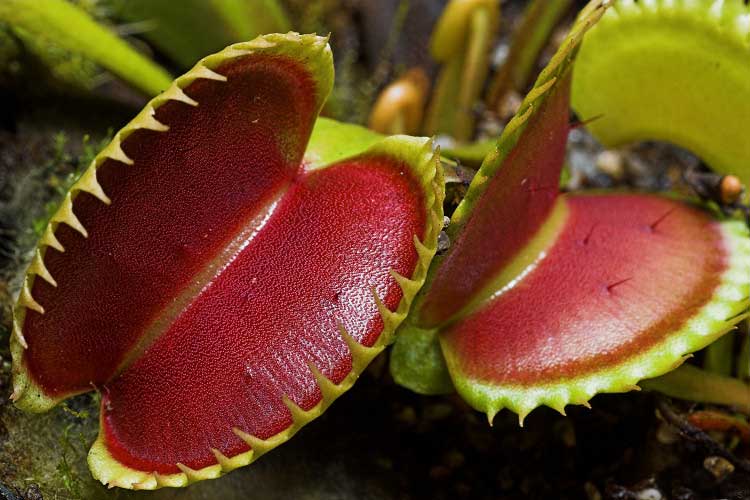
the Venus flytrap, native to the swamps of North and South Carolina. Its leaves are brightly colored and produce a sweet smelling nectar. Each leaf consists of two lobes joined by a hinge, like a clamshell, and each lobe is edged with stiff bristles called cilia. Inside each lobe are three trigger hairs. When the trigger hairs are brushed by an insect, the bristles come together to form the bars of a cage, and
50
the insect is trapped. Within about ten days the insect becomes a nitrogen-rich soup of nutrients that is absorbed by the plant. Then the trap opens again, ready to attract its next victim. One flytrap may capture and digest three “meals” per month.
Perhaps the most unusual active trapper is the bladderwort. The bladderwort floats below the surface of the water and
60
extends a network of leaves, which are like little airbags or bladders only half a centimeter long. Like the leaves of a Venus flytrap, the bladders are equipped with trigger hairs at the opening of a trapdoor that opens in only one direction—inward. While awaiting its prey, the bladder lies limp and empty. When a small animal brushes the trigger hairs, the trapdoor springs open, allowing water to rush in.
70
The prey is sucked inside, the trapdoor closes, and the bladderwort obtains the nutrients it needs to survive.
Passage 4:

Sometimes in nature, a plant or animal depends on another species for its survival. Once in a while, the existence of a single species is crucial to the survival of a large number of other life forms. An excellent example of such a species is the sea otter, a carnivorous marine mammal that lives in the rich kelp forests (dense areas of seaweed) in the coastal waters of the Pacific Ocean.
10
Sea otters have long been hunted for their valuable and beautiful fur. Before the governments of the United States and several other countries enacted laws banning their slaughter early in the twentieth century, the sea otter’s numbers were dangerously low. Though they presently occupy only a fraction of their original habitat range, sea otters are thriving again. Today, they are often seen
20
in California coastal waters in a characteristic pose: floating happily on their backs while eating a seemingly endless supply of seafood.
The sea otter seldom visits land, except to escape severe wind and waves or to give birth to young. It is quite at home in the kelp forest, which provides protective cover from enemies (including sharks and killer whales) and serves as an abundant
30
source of its favorite seafoods. A sea otter may consume as much as twenty pounds of shellfish a day, feasting on mollusks, abalone, crabs, and its favorite treat—sea urchins.
The sea otter’s eating habits are good news for the other inhabitants of its environment. Another big eater, the sea urchin, lives on a diet of kelp and seaweed. In some areas, uncontrolled sea urchin growth has devastated kelp forests.
40
When sea urchin populations are held in check, and water pollution or shoreline development do not interfere, kelp forests generally thrive. Many varieties of fish and shellfish live in these seaweed forests, attracting still more animal species to nearby shores. For example, the survival of bald eagles and harbor seals depends on the availability of such marine life. Had the hunting of sea otters continued
50
unabated into the twentieth century, the damage to this interdependent coastal community would have been much more far-reaching than the loss of an individual species.
Passage 5:
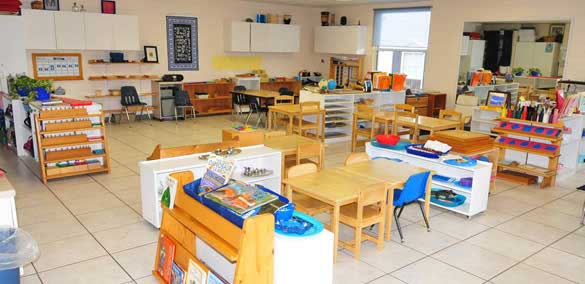
If you look around most preschool classrooms, you’ll notice some common elements: rows of beads to count; wooden blocks and textured objects to touch; and furniture made to the scale of a small child. All of these familiar objects reflect the deep influence of Maria Montessori and her theory of education.
Born in 187 0 in the Italian village of Chiaravalle, Maria moved to Rome with
10
her family when she was five years old. Her mother encouraged her to pursue broader schooling than most girls received at the time. Maria began attending a boys’ technical school at age 13, against her father’s wishes but with her mother’s support. She spent seven years studying engineering—and developing ideas about what a school should not be like. Although she was a good student, she felt stifled by
20
the strictness, formality, and emphasis on learning by memorizing.
Eventually Montessori enrolled as a medical student at the University of Rome. In 1896 she graduated as the first female doctor in Italy. The following year, she joined the staff at a hospital for children with developmental disabilities. As she observed her patients, Montessori realized that many belonged in school, not
30
in a hospital. Though not trained as a teacher, she wanted to find ways to educate these children.
Montessori drew ideas from anthropology, psychology, and medicine to develop her educational methods. She believed that children’s personalities form as children interact with their environment. Everything they experience, she thought, becomes part of them.
40
Montessori believed that the classroom environment was part of education. She was the first educator to provide child-size chairs and tables.
She also believed that education is a natural process that each student conducts in his or her own way. Teachers can help the process, but they should not attempt to direct it or change it. Children were given the freedom to learn in their own way, while at the same time required to follow classroom rules. In contrast to the commonly held view that children
50
should be “seen and not heard,” Montessori’s teachers allowed their students to discover knowledge without interference. In 1900, Montessori put her ideas into practice by opening a small school for children with developmental disabilities. The results were remarkable. Although her students were thought to lack ability, they learned to read, write, and participate in classroom activities. In
60
1907, Montessori founded a school for preschool children in one of Rome’s poorest neighborhoods. Most of the children were shy and fearful or unruly and wild, but all responded quickly to Montessori’s methods. Her students’ success made Montessori famous, and she traveled the world to spread her ideas, revolutionizing education everywhere she went.
70
Montessori had her critics as well as her admirers. Some claimed that her methods placed too much emphasis on hands-on learning instead of intellectual development. Others questioned whether young children could achieve their own education without the structure and knowledge that a good teacher can provide. But educators agree that Maria Montessori recognized the universal
80
characteristics that all children share, and she taught the world that each child is unique, admirable, and worthy of respect.